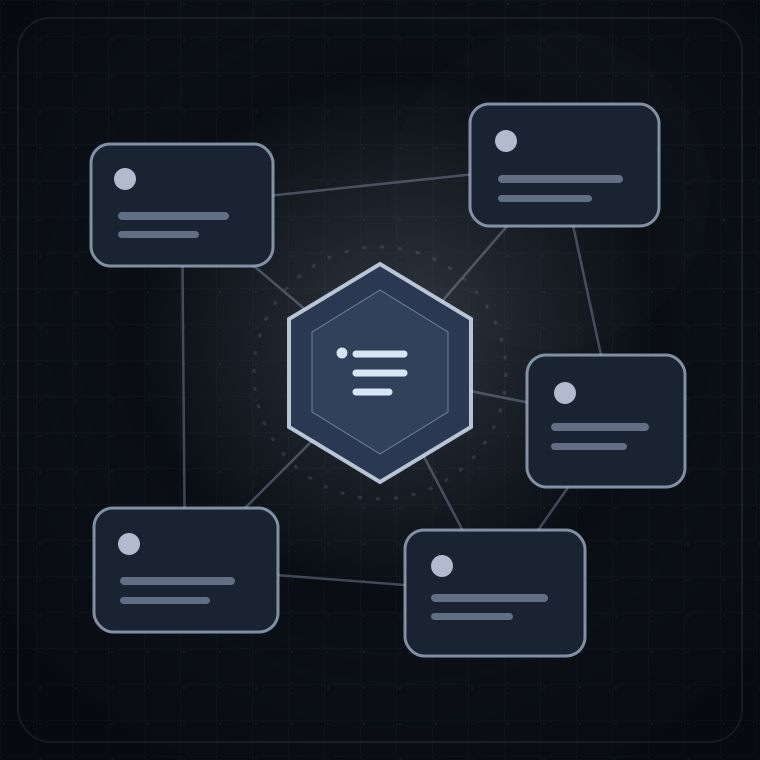
The problem with isolated assistants
Most marketing teams don't lack dashboards, prompts, or automation. They lack a continuous way to connect what the market is saying with what the business is doing and what the results should change.
A research assistant can find a tactic. A reporting dashboard can measure activity. A content tool can generate a draft. If none of those systems shares evidence, context, guardrails, or feedback, the team still has to assemble the decision by hand.
Design around decisions, not agents
I'm exploring a broader marketing operating system: specialized capabilities that monitor credible sources, understand a company's positioning and products, evaluate ideas against the current strategy, plan bounded experiments, coordinate permitted execution, and learn from outcomes.
The fundamental unit isn't an AI agent. It's an accountable decision. Where did the idea originate? What evidence supports it? What are we changing? Which audience does it affect? What would count as success? When do we stop or revise?
Autonomy without losing control
A useful system has to remember more than tasks. It needs an audit trail of source URLs, authors, timestamps, assumptions, approvals, and outcomes. It needs access boundaries between clients or brands. It also needs to know when the data is insufficient and a human should decide.
This is an ongoing design and build effort, not a claim that I've already deployed a fully autonomous marketing organization. The work is interesting precisely because closing the loop—from signal to action to evidence—is the difficult part.